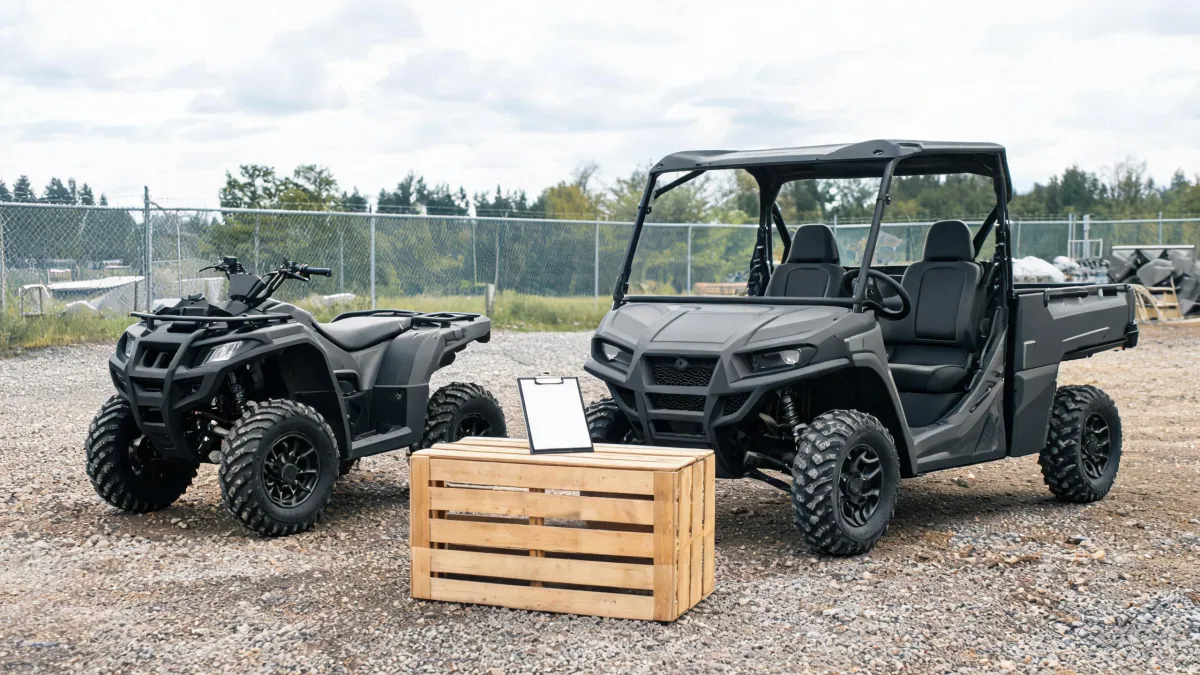
A trailer that feels light on the ball can still put a 2025 Polaris Sportsman 850/XP 1000 over its limit. The failure is rarely dramatic at first. A rear rack carrying a cooler and a fuel can, a hitch with a tall rise, tongue weight nobody counted, and a belt working harder than it should on a long pull. The bill shows up as heat at the hitch, steering that goes vague in a turn, a belt that quits early, and a load plan you rebuild from the manual anyway.
Tongue weight is not a trailer-side number. On this machine it belongs inside the vehicle's total load, and it also competes with rear-rack cargo, because the trailer tongue pushes down on the hitch and that force runs into the same frame that carries the box. The trailer can track well and still be the reason the machine is over capacity once you add the operator, the accessories, the cargo and the weight on the hitch.
What a Tongue-Weight Mistake Costs
Wrong tongue-weight math is cheap to fix in the driveway and expensive to fix on a grade. The first cost is heat. Polaris says not to use a receiver hitch with a rise of more than two inches because the trailer hitch or the trailer tongue can get too hot, and you cannot weigh your way out of that problem, because the variable is geometry rather than mass. The second cost sits on the rear rack, where a box full of tools can quietly eat the room your trailer tongue needs while the machine still looks fine on the big total.
Then there is the belt. The manual points to low forward gear for heavy towing precisely because belt life is at stake, and a belt that fails mid-season is a repair you did not schedule. None of these outcomes calls for a bigger trailer or a different machine. They call for counting what you already own, in the right order, on one page.
Tongue Weight Counts Inside Total Load
The total load on this model is defined as operator, accessories, cargo and weight on the hitch, and that total must not exceed the maximum weight capacity of the vehicle. That list is not paperwork. The trailer tongue rests on the hitch and pushes down on it, and the downward force travels into the ATV's frame, tires and suspension the same way a loaded cargo box does.
The reason tongue weight cannot sit outside the payload math is that the ATV is what holds it up. The trailer is not carrying its own tongue load; the machine is. Which means the number you read from a tongue scale belongs in the same column as the rider and the cargo, and that capacity is the column total, never a trailer-only figure. A trailer rated comfortably below its own limit tells you nothing about the machine holding its tongue.
Rear Rack Capacity Is a Shared Budget
Rear rack capacity is a separate check with its own ceiling, and it is easy to skip because the total-load math looks like it already covered everything. It did not. Rear rack cargo plus tongue weight must not exceed rear rack capacity, and both loads feed the same rear structure, so they share one budget instead of stacking as two independent allowances.
Picture a machine with room left in the total on paper while the rear rack is already at its limit under a loaded box. The tongue weight has nowhere to go even though the big number still looks open. That is how a setup that seems legal ends up overloading the rear of the vehicle. Which means the rack check is not a duplicate of the total check; it catches a failure the total cannot see.
Build the Load Sheet in Order
Start with the maximum weight capacity printed for your exact model and installed equipment, then enter the operator, then every accessory actually bolted on, then the rack or box cargo, then the trailer tongue weight. Compare that running total against capacity. Only after that comparison closes, run the rear-rack check by adding rack cargo to tongue weight and holding the result against rear-rack capacity. Each item is entered once.
The common arithmetic error is entering tongue weight twice, once as cargo and once as hitch load, or counting a winch as cargo when it is an accessory that never comes off the machine. Both mistakes inflate one line and hide the real headroom you have. Confirmation is unglamorous: one page, one set of numbers, the same figures used in both comparisons, and two separate verdicts written down. If the page only shows the total check, the job is half done.
Keep the Receiver Within Two Inches
The manual caps receiver rise at two inches, and it caps the drop or raise at two inches as well. The stated reason for the rise limit is heat at the trailer hitch or the trailer tongue, which tells you the rule is about geometry, not weight. A tall rise lengthens the lever between the receiver and the ball, and the manual treats that arrangement as a heat risk. Which means a hitch can be perfectly fine on weight and still be the wrong part for this machine.
The boundary matters here. This is a limit written for the 2025 Polaris Sportsman 850/XP 1000 and it does not transfer to another model without checking that model's own manual. Measure the rise or drop before you bolt anything together, and if the ball height you need demands more than two inches of correction, check the trailer side before adding a taller adapter to the ATV.
Plan Around the Towing Speed Limits
Ten mph is the ceiling on level ground. Five mph is the ceiling in rough terrain, while cornering, and while ascending or descending a hill. Those limits are where route planning actually happens. A trailer's momentum grows with speed, so it takes more distance and more control authority to stop or redirect it, and a machine that feels planted at ten mph on flat gravel can feel like it is steering you on a side slope. Side forces in a turn grow the same way, and a grade adds a pull you never had on the flat. Dropping the ceiling to five buys back control time in exactly the places where the trailer can push the ATV instead of following it. Which means a route with a ditch crossing, a tight turn or a hill is a five mph route for its whole length, not a ten mph route with one slow corner in the middle.
Use Low Gear for Heavy Towing
Low forward gear is the ratio the manual specifies when hauling or towing heavy cargo, and the stated purpose is longer belt life. A belt drive moves load through a friction interface, and a heavy trailer keeps that interface working harder for longer; the manual's low-gear instruction is the operating choice it gives to reduce that strain.
Gear selection is a load-management decision rather than a comfort preference. The trade is ground speed and a coarser feel on descents, and it is worth taking whenever the trailer is genuinely heavy. What counts as heavy is a judgment the manual leaves with the operator, so let the load sheet decide: if tongue weight plus cargo has eaten most of your remaining capacity, plan the pull in low forward gear from the first foot.
Confirm the Setup Before the First Tow
Before the first loaded pull, put the numbers on one page and keep that page with the machine. It needs the maximum weight capacity and the rear rack capacity for your exact machine, four entries for operator, accessories, rack or box cargo and tongue weight, and two comparisons written out: the four entries against capacity, and rack cargo plus tongue weight against rear rack capacity.
Add the measured receiver rise or drop, the route's speed zones recorded as ten mph where the ground is level and five mph anywhere it is rough, turning or graded, and a line stating that low forward gear is the plan for a heavy tow. Sign it and date it. Redo it whenever the cargo, the passenger or the trailer changes, because a page that was right for one trip is not a standing permission for the next. The manual remains the authority; this sheet is your record of its limits.
The action for today is short. Copy the two capacity figures for your machine onto paper, fill in the four entries with real numbers, and run both comparisons before you couple anything up. If the sheet does not close, you found the problem in your driveway instead of on a grade with a trailer pushing you downhill.
