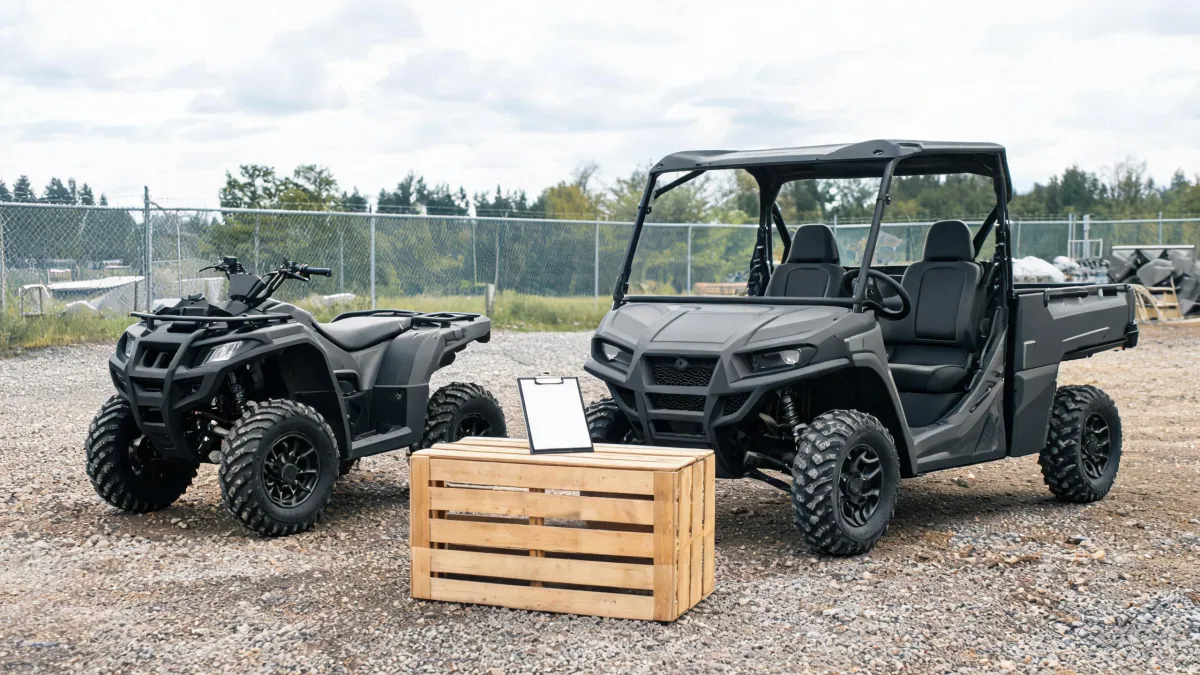
Release of an adult ATV is a documentation decision, and on the 2025 Polaris Sportsman 850/XP 1000 the first hard gate is simple: it is an adult vehicle only, and operation is prohibited for anyone under 16. Above that floor, the manual separates two further conditions: the operator must understand how to operate properly in different situations and on different types of terrain, and a guest may not operate the unit unless that guest has read the manual and all product labels and completed a certified safety training course. A guest is exempt from none of it, so the unit stays parked until those confirmations exist, no matter how old the person at the tailgate looks. Every requirement below is scoped to that model's owner manual, publication 9941698 R02; a different machine needs its own manual read the same way.
The dealer releasing a demo on Saturday and the fleet coordinator releasing a work unit on Tuesday can face the same gap: the machine is ready, the paperwork is not, and nobody wrote down which of them was supposed to close it.
Who Is Eligible to Ride This Adult ATV
The owner manual for the 2025 Polaris Sportsman 850/XP 1000 classifies the machine as an adult vehicle only and prohibits operation by anyone under 16 years of age. That is one hard number tied to one model, and it should not be carried across to other ATVs on the lot or to the category at large.
The manual then draws a distinction that matters more than the number itself. A child may sit inside the recommended age group for operating some ATVs and still lack the skills, abilities, or judgment needed to operate or ride this ATV safely, which means 16 is a floor and not a clearance. Below the line, release is prohibited outright. Above it, the rider has passed exactly one gate and the remaining conditions are still open.
Why Age Alone Fails as a Release Gate
The documented failure modes for this machine are collision, loss of control, accident and rollover, and each is produced by inputs the operator supplies — throttle, brake, body position, the line chosen across a slope — in situations the vehicle cannot detect for itself. Because the machine only reacts, the release decision is a prediction about the rider's judgment rather than a statement about the vehicle's condition. Age is a proxy for that judgment, and a coarse one: it correlates with judgment across a population while saying almost nothing reliable about the individual holding the handlebar.
Instruction and terrain exposure are the direct variables, which is why the manual keeps the prohibition on riders under 16 and the demand that the operator understand how to operate properly in different situations and on different types of terrain as two separate requirements instead of one combined test. Terrain competence is specific by construction; a rider smooth on gravel has demonstrated nothing about a sidehill, a rutted climb, or a loaded descent, and the phrase about different types of terrain is the part a single afternoon cannot satisfy.
The practical consequence at handover is that risk concentrates at the edge of a rider's experience — the first unfamiliar surface, the first unit heavier than the last one, the first pass with a trailer attached — and that edge is invisible on a driver's license.
Guest Riders Need Three Separate Confirmations
Guests get their own clause, and it is stricter than the age line. A guest may not operate the ATV unless the guest has read the manual and all product labels and has completed a certified course in safety training. That is three separate confirmations, and collapsing them into one signature is where handovers go wrong.
Reading the manual is a document you can hand someone. Reading the product labels is a different act on a different surface, the warnings affixed to the machine itself, which a rider who skimmed a PDF on a phone has not necessarily seen, especially where a decal has been replaced or has worn through. Completing a certified course is a third item with a third kind of proof, and the only one of the three that involves a party outside your building.
A guest is the riskiest release precisely because they carry no familiarity with the unit. The regular operator knows what changed since last week; the guest has no baseline at all. Whether you record those three confirmations on one sheet, in a dealer system, or in a message thread is your choice — the manual names the conditions, not the filing method.
The Release Order and How to Confirm Each Step
Run the checks in this order and keep the proof attached to the release. First, eligibility: confirm the named rider is not under 16 for this adult vehicle, from a date of birth or an ID rather than an estimate. Second, instruction: confirm the rider has read the owner manual for the exact unit and the labels affixed to it.
Third, training: for a guest, confirm a certified safety training course has been completed; for any beginning or inexperienced operator, check that the recommended safety training was completed before operation, as the manual directs for that group. That sentence splits your roster in two, the experienced hand and the first-timer, and the second group needs the training confirmation before the key moves rather than after the first weekend.
Fourth, impairment: no alcohol or drugs before or while operating, because that state can degrade judgment, reaction time, balance and perception. This is the one item that cannot be documented after the fact, so it has to be a face-to-face check at the moment of handover. Fifth, condition: the pre-ride inspection is performed before each use to establish that the vehicle is in safe operating condition.
For every step, name the object you would point at if asked: a date of birth on file, a signed manual acknowledgement, a course completion record, a named person who looked the rider in the eye, an inspection finished before the unit left. A condition nobody can point at cannot be verified, which means an undocumented step is effectively an unperformed one. That standard is uncomfortable, and it is the only one that survives a question asked six months later.
Why the Pre-Ride Inspection Stays With You
Take the position plainly: the pre-ride inspection belongs to the party releasing the machine, not to the rider's own routine. Failure to inspect and verify safe operating condition before operating increases the risk of an accident, and the inspection is required before each use, which makes it a release condition rather than rider etiquette.
The reasoning is information asymmetry. A rider who has just been handed a machine has the strongest incentive to ride it and the weakest information about what changed since the last inspection — a slow leak, a bent component, a guard left loose after service. The party that had custody of the unit is the only one who can honestly confirm its starting condition, because that party is the only one who saw it before the handover.
That preference has a price, and the price is paid in time. The releasing party carries the minutes at every handover and the record burden afterwards, while a rider's own walkaround costs the business nothing. The trade is worth naming out loud so nobody pretends the choice is free: you are buying a defensible starting condition with someone's labor. Which items the inspection covers comes from the manual's checklist for this model, not from anything invented here.
Keep the inspection on the releasing side, then, and treat a rider's own check as a supplement rather than a substitute.
Where This Checklist Stops Being Enough
Everything above is bound to the 2025 Polaris Sportsman 850/XP 1000 manual. It does not establish requirements for other models, for machines sold in other markets, or for state-level operator certification rules that may sit on top of the manufacturer's conditions; those get checked against the manual shipped with the specific unit and against the buyer's own jurisdiction.
Suppose a dealership decides to add its own sign-off sheet, a fixed retention period for training records, and an annual refresher for repeat riders. That is a policy choice, clearly labeled as one, and this evidence neither mandates nor forbids it. Additions like those raise the release bar; they cannot replace the conditions the manual actually names, and a shop that swaps its own sheet in for a guest's course completion has traded a requirement for a habit.
The tradeoff runs the same way through all of it. Stricter internal gates cost handover time and buy defensibility, and every fleet sets that dial somewhere different depending on who is likely to ask questions afterwards: an insurer, a customer, a state inspector, or a plaintiff's attorney.
Before the key changes hands, confirm one thing: that the training record — certified for a guest, recommended for a beginning or inexperienced operator — is matched to the named rider and this adult model. That is the check to keep, because the age line announces itself at handover while a training record does not, and of everything the manual requires, training completion is the condition easiest to assume and easiest to leave unproven.
